← Blog
Research
2026-05-02
9 min read
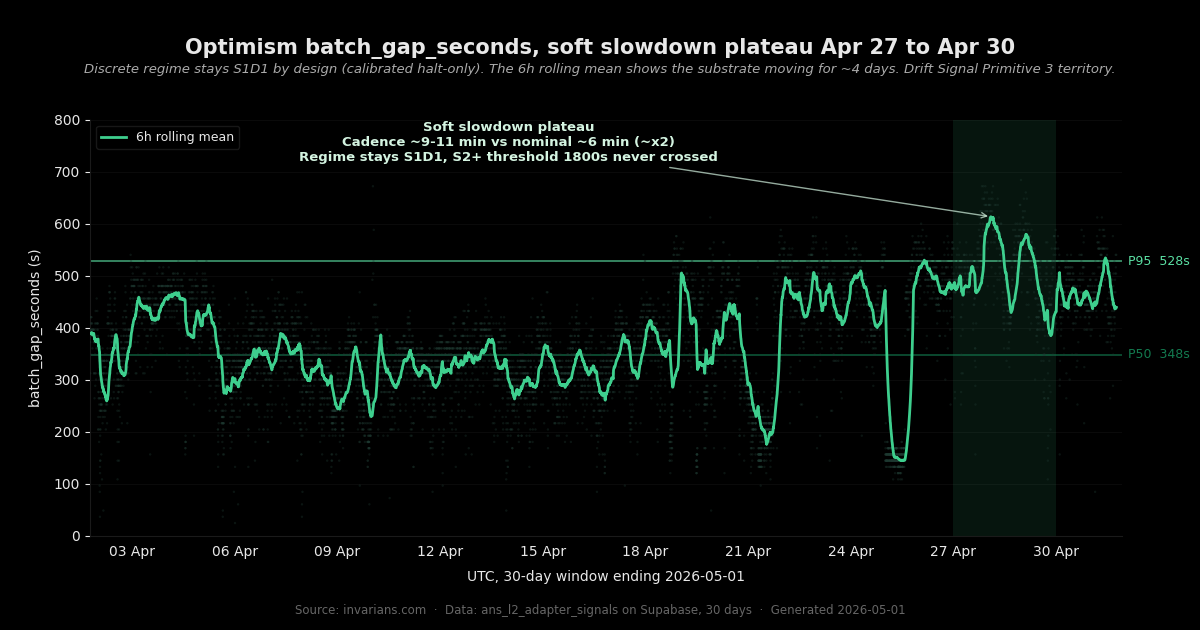
When a soft slowdown breaks RWA timing assumptions: Optimism, April 27 to 30 2026.
Imagine an AI agent settles a tokenized treasury fund on Optimism, then cross-chain messaging propagates the settlement state to Ethereum L1 for the registry update that closes the trade. The messaging layer (an attestation bridge in this scenario, not the native canonical bridge with its 7-day fault-proof window) relies on Optimism's L2-to-L1 batch posting cadence (~8 minutes nominal) to know when L2 state is committed on L1, well within the 30-minute SLA the custody partner publishes. For 4 days in late April 2026, that cadence drifted 70 percent slower than nominal. The bridge worked. Settlements completed. But every cross-chain coordination assumption the agent made, when L1 state-commitment freshness should be checked, when the registry update should propagate, when the SLA milestone passes, was operating outside its calibrated range.
Nothing alerted the agent. The regime classification said S1D1, nominal, throughout. By design, soft slowdowns do not trigger regime changes. They are exactly what the third primitive of API v2.0, the Drift Signal, is built to surface.
This article is for teams building RWA agents on L2 rollups: tokenized treasuries, real-estate share registries, settlement orchestrators, compliance-monitored flows. Concretely, the architectural pattern at stake is the one common to multi-chain RWA flows where cross-chain timing assumptions are part of the contract or audit trail. The Optimism cluster of late April 2026 is the illustration. The risk it surfaces is structural, and applies to any RWA flow whose contractual or audit guarantees depend on predictable cross-chain state-commitment timing.
Invarians sits one layer below cross-chain attestation services (Chainlink CCIP, Data Streams, LayerZero, Wormhole) and reserve attestation (Chainlink Proof of Reserve), which route messages, expose state, and attest reserves but do not classify substrate health. The substrate-state primitive is what downstream attestation infrastructure and agent logic read to size their timing assumptions and detect drift before it becomes contractually consequential.
Why nothing alerted you
The S2+ threshold for Optimism is calibrated for halts: the SequencerInbox stops, batches do not post for tens of minutes, the L2 finality channel breaks. Documented OP halts (2024-11, 2025-09-14, earlier incidents) show batch gaps in the 1800 to 10800 second range. The calibrated threshold at 1800 s catches every documented halt with margin and emits zero false positives across 30 days of nominal data.
If the threshold were set lower, say 720 s, every transient soft slowdown would flip the regime to S2+. Two consequences. First, an agent built to defer execution on S2+ would have stopped serving Optimism for days at a time, over slowdowns that posed no actual finality risk. Second, the meaning of S2+ would dilute: it would now mean "either halt or soft slowdown", and an integrator could no longer treat S2+ as a hard stop signal.
So the calibration is right. S2+ is for halts. Soft slowdowns belong somewhere else.
Five RWA agent classes affected by a 4-day cadence drift
For an RWA agent, predictable cross-chain finality timing is often a contractual or audit-grade input. Even a sub-halt drift of +70 percent in batch posting cadence ripples through the assumptions on which the agent's logic is built.
| RWA agent class | Risk under sustained +70 percent cadence drift |
|---|
| Tokenized bond settlement agent | T+1 settlement window with intermediate milestones (lock at T, L1 state-commitment check at T+30 min via attestation bridge). When the check lands at T+35 min instead of T+30 min (drift propagates the 8-minute nominal posting to ~14 minutes), the milestone clamps tight against its budget; manual escalation triggers if the downstream pipeline lacks a proportional buffer; contract dispute risk increases. |
| Cross-chain tokenized real-estate share | Asset on L2, registry on L1, regulator subscribed to L1 events. L2-to-L1 finality lag means registry updates land late and regulator monitoring may misfire (false alerts: "transaction not yet finalized?"). |
| Treasury rebalancing agent | Daily rebalance: lock position on Optimism at 00:00 UTC, expect L1 finality by 00:10 to validate downstream pipeline. At 00:17 instead, downstream timeouts misfire, retries trigger, risk of dual-execution if the retry path is not idempotent. |
| Compliance-monitored RWA flow | Audit trail expects "settlement finality within X". Soft slowdown means some settlements lag X, requiring manual flagging in audit reports. Cumulative noise on regulator-facing reporting; audit fatigue, harder to spot real anomalies. |
| Multi-chain settlement orchestrator | Coordinates finality across L1 plus two L2 rollups. If one L2 has +70 percent finality time, the orchestrator's coordination assumption breaks. Either it waits longer (delays all chains, including those operating normally) or it proceeds with partial finality (correctness risk). |
None of these failure modes triggered an alarm in late April 2026. The regime stayed nominal, the bridge kept posting, settlements completed. But for an agent whose contract guarantees rest on timing predictability, "completed" is not enough; the question is "completed within the calibrated window I committed to". For 4 days, that answer was different from the previous 30.
What Drift Signal exposes for an RWA agent
The Drift Signal is a continuous reading of how far each metric has moved from its long-term baseline, and whether it is moving further or reverting. For every classifying observable, the panel exposes (in diagnostic mode) a MetricBlock:
ratio: short EMA value, same one the regime classifier uses.ratio_long: long-term baseline (~30 days).shift = ratio - ratio_long: how far the metric has moved from baseline.shift_delta: direction of value movement between two consecutive cycles.shift_magnitude_delta: whether the deviation is growing or shrinking.
For an RWA agent on Optimism, the relevant signal during the late April cluster is sequencer_publish_latency.shift on the structural axis. The value would have been positive and sustained at roughly +70 percent of baseline for 4 days. (This metric activates on the live panel once a 30-day EMA on batch_gap_seconds stabilizes, around end-May 2026 for chains added in v2.0; raw seconds is exposed in the meantime, see the disclosure section below.) An RWA agent reading this stream does not halt, does not freeze, does not stop serving Optimism. Instead, the agent recalibrates its timing assumptions on the fly:
- State-commitment freshness check moved from "expect within 8 min" to "expect within 14 min".
- SLA milestone buffer extended proportionally for new settlements initiated during the drift window.
- Audit-trail timestamps annotated with the prevailing drift magnitude, so the audit trail itself records the operating point at execution time.
- Regulator-facing alert thresholds widened temporarily to avoid false positives during the slowdown. The widening rationale is auditable: the drift magnitude is recorded in the signed payload, so the threshold extension is reproducible from the panel record at execution time.
The same logic, expressed through the panel API:
panel = client.get_panel_v2(chains=["optimism"], include="diagnostic")
op    = next(e for e in panel.l2 if e.chain == "optimism")
shift = op.structural.metrics["sequencer_publish_latency"].shift

if shift > 0.5:
    finality_buffer = nominal_buffer * (1 + shift)
    audit.annotate(drift=shift, buffer_extended=True)
None of this requires the regime to flip. The regime is doing exactly what it should: not flipping on soft variations. The Drift Signal carries the continuous magnitude that an RWA agent uses to size its timing buffer and document its operating context.
The Optimism late April 2026 cluster as illustration
Numbers that characterize the cluster, drawn from 30 days of batch_gap_seconds on Optimism:
| Metric | Value |
|---|
| Top-tail observations during cluster | 18 with batch_gap_seconds >= 648 s across 48 hours (mean ~660 s, x1.9 nominal) |
| 6h running mean during cluster | ~580 s (x1.7 nominal ~348 s) |
| Max single batch gap | 732 s (x2.1 nominal, well below S2+ 1800 s) |
| S2+ threshold (calibrated halt-only) | 1800 s |
| Regime emitted | S1D1 throughout the cluster |
| Earlier smaller bump | 2026-04-21 to 2026-04-22, running mean ~520 s for ~24 hours (x1.5 nominal), then returns to baseline |
The chart at the top of this article shows the 6-hour rolling mean over the full 30 days. The plateau between April 27 and April 30 is the headline cluster. The smaller bump on April 21 to 22 (~24 hours, x1.5 nominal) is mentioned to make explicit that soft slowdowns of varying intensity recur on Optimism, not as point events. Its shorter duration and lower magnitude relative to the headline cluster is itself useful structural information for an RWA agent calibrating its buffer policy.
Limits, honest disclosure
The data characterizes the slowdown. It does not explain it. Possibilities include sequencer-side congestion on Optimism, blob market saturation upstream on Ethereum L1 affecting all rollups simultaneously, scheduled maintenance, or a mix. Cross-checking against Arbitrum and Base running means over the same window would constrain the hypothesis (correlated drift across all three rollups suggests upstream blob saturation; drift isolated to Optimism suggests sequencer-side or OP-specific maintenance). That comparison is not in this article.
One headline cluster plus one smaller bump on a single chain over 30 days is not enough to claim a generalizable pattern. Multi-month observation across the three L2 rollups is the open research follow-up, publishable as research/SHIFT_PREDICTIVE_VALIDATION.md.
Per-metric shifts on sequencer_publish_latency activate in the panel API once the long-term EMA on batch_gap_seconds stabilizes (~30 days post v2.0 launch). Before activation, the panel exposes the raw seconds value, and an RWA agent can derive its own deviation against a self-computed baseline.
Operational footprint: panel queries return a single signed payload in well under 100 ms; agents typically poll every 60 to 120 seconds. No upstream blockchain RPC cost is added on the agent side, Invarians performs the on-chain reads centrally and signs the result. Polling is the current integration mode; webhook-on-shift-threshold and Chainlink Functions / Automation integrations are on the v2.1 roadmap for event-driven RWA architectures where 60-second pull latency is too coarse.
With Drift Signal wired in across the same April 27 to 30 window (a customer pilot is the natural next step before this becomes a publishable case study), the operational picture changes: settlements complete with proportionally extended buffers, milestones do not miss the wider clock, audit trails record the drift at each execution instant, regulator alerts stay quiet because their thresholds move with the operating point. The infrastructure is observed and accommodated, not interrupted.
The point of this article is not the case study; the case study is the illustration. The point is the architectural choice: regime classification calibrated halt-only, Drift Signal exposed alongside, RWA agent composes its own timing buffer from both. For RWA flows where settlement timing is contractual, that composition matters more than any single event.
Invarians
Invarians provides on-chain execution context for AI agents. API v2.0 exposes three primitives in a single signed payload: Attestation (HMAC), Regime (12 signed codes per chain), Drift Signal (per-metric shift, per-axis composite). Built for RWA flows where settlement timing is contractual, audit-grade, and SLA-bound. Live since 2026-04-30 across Ethereum, Polygon, Arbitrum, Base, Optimism.
See how it works →
